

great-cto
🔌Plugin🧩 ModA tool that runs Claude Code work in clear stages with reviews and checks, and can try the same with Codex. A local board shows your tasks, what ran, project documents and usage in one place.
Installation
/plugin marketplace add avelikiy/great_cto/plugin install great_cto@great-ctoRun these in Claude Code. In a session that is already open, run /reload-plugins after installing.
Permissions to check
- Network
Also: Interface · /commands · Own data · Environment · Session info
Raw check output (Claude Code 2.1.322)
hooks: session.start, command.run{command=gates}, turn.complete, ui.render{component=Pane, requestId=great-cto-gates}
calls: $.clock.every, $.command.register, $.env.get (via locate), $.http.fetch (via decide, refresh), $.session.root (via projectOf), $.state.get, $.state.set, $.ui.open, $.ui.resolve, $.ui.status (via refresh), $.ui.toast (via decide, refresh)
env reads: BOARD_PORT
README.md
View on GitHub →See the work. Trace the decisions.




Actual 3.70 interface. The graph uses an offline controller run with stub responses, not live models.
Legacy 3.70.1 command. See the verified distribution boundary below for current activation limits.
npx great-cto init
Website · One real run → · Blog · Changelog
Русский · 简体中文 · 繁體中文 · 日本語 · 한국어 · Español · Português · Deutsch · Français
Keep the task, its checks and your next decision connected.
great_cto coordinates Claude Code workflows and experimental controlled Codex runs through explicit stages, review and gates. The local board brings tasks, recorded execution, project documents and consumption into one workspace. Missing evidence stays unknown; a successful worker is not proof that a task was accepted, merged or deployed. You use your own provider account; great_cto is MIT and bills nothing.
Project focus presents eight core roles plus the selected project's required reviewers. The full catalog of 73 agents remains available. Catalog availability is not proof of execution or expertise.
Quick start
Verified distribution boundary (ADR-045): this implementation replaces mutable installers
with verified artifact admission. init, native plugin refresh and automatic
companion installation currently refuse activation. Plain npm self-update needs
the separately configured verifier and a signed release artifact set. This is
not evidence of an installed or published update. See
verified updates for the supported boundary.
The commands below describe the legacy 3.70.1 installation flow; they are not
an activation route for this implementation.
npx great-cto init
Restart Claude Code. Day to day there are three things:
| In Claude Code | In the terminal | |
|---|---|---|
| Start work | /start "add Google login" | great-cto run "add Google login" |
| See what needs you | /inbox | great-cto status |
| Continue | /resume | great-cto resume |
/start takes a new product or a task in an existing project and picks the
workflow itself. /resume continues only what you already approved; a pending
decision still waits for you. Everything else — /review, /spec, /save,
/digest and the rest — is there when you need it:
all commands.
Setting up through an AI agent? Paste the one prompt in Quick start for AI agents into Claude Code or Codex.
One project, five views
Run great-cto board to open the local board, normally at localhost:3141.
Readings such as unverifiable, unmeasured and unavailable are not passes.
| View | What you can inspect |
|---|---|
| Work | Tasks, acceptance criteria, the next supported action, and Overview / Execution / Evidence tabs |
| Decisions | Pending decisions and existing gate controls, without broadening their authority |
| Knowledge | Read-only project Markdown, ADRs and a bounded diagram viewer with Mermaid source fallback |
| Insights | Recorded task outcomes, project-scoped token consumption, estimates and budgets kept separate |
| Settings | Executors, Runtime, Capabilities and General controls |
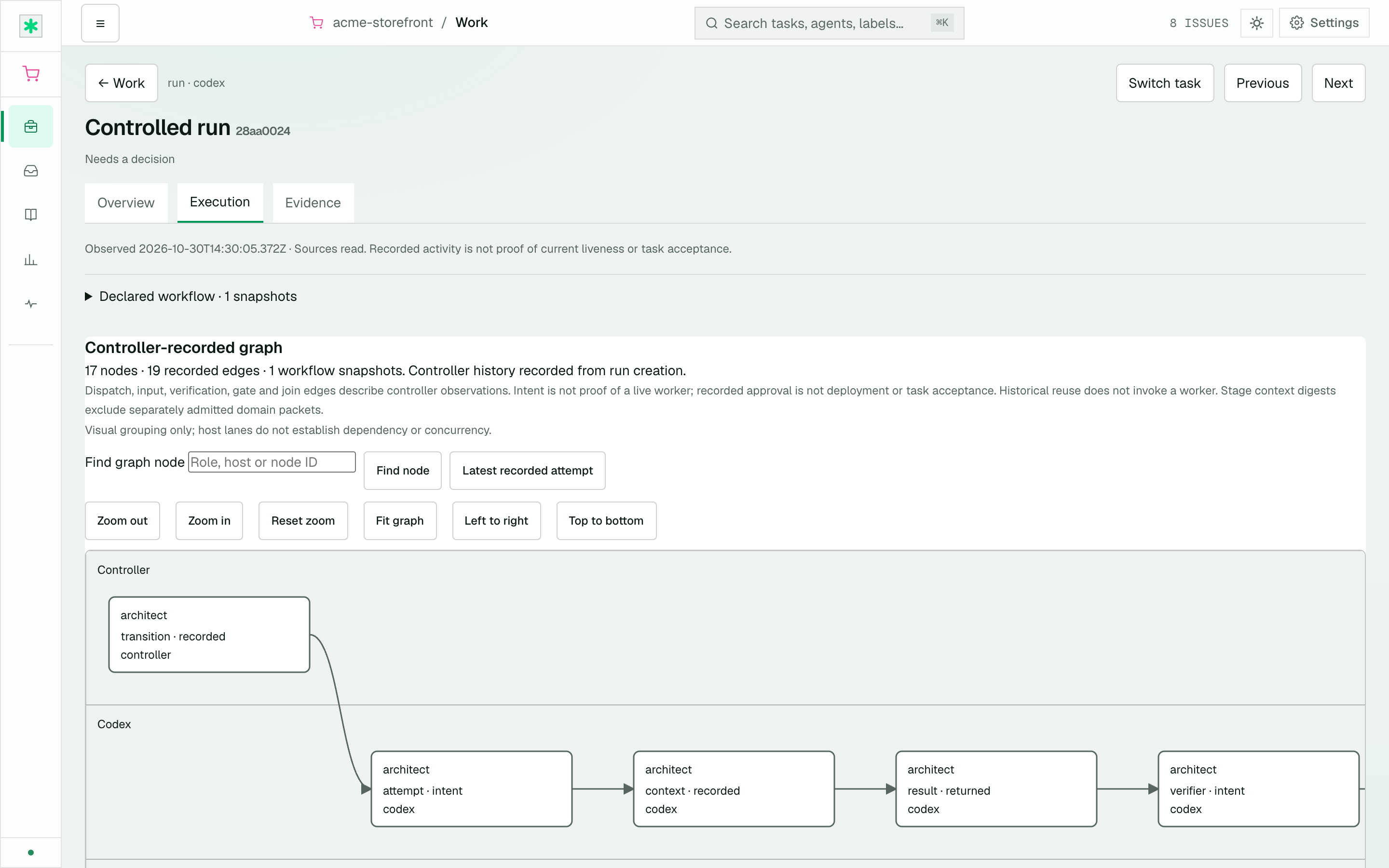
Execution shows controller-recorded causal history for controlled runs, including attempts, checks, verification, gates and repair. Native and legacy sessions stay partial or unavailable; missing edges are not inferred. This is not a live terminal or workflow editor. The sample graph comes from offline stub responses, not models.
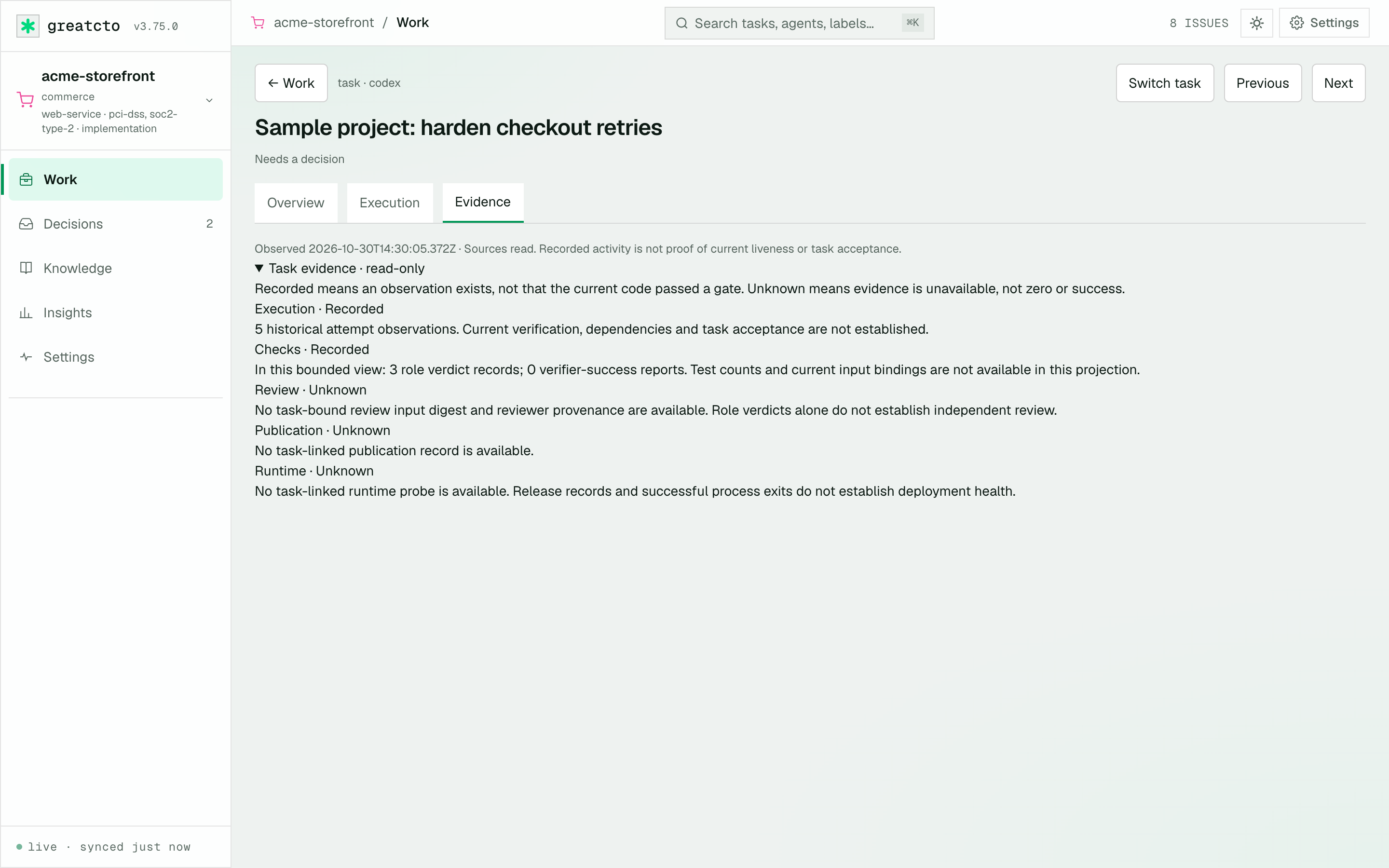
A role verdict is not independent-review proof. Merge, release and deployment need their own evidence; unknown is not zero or pass.
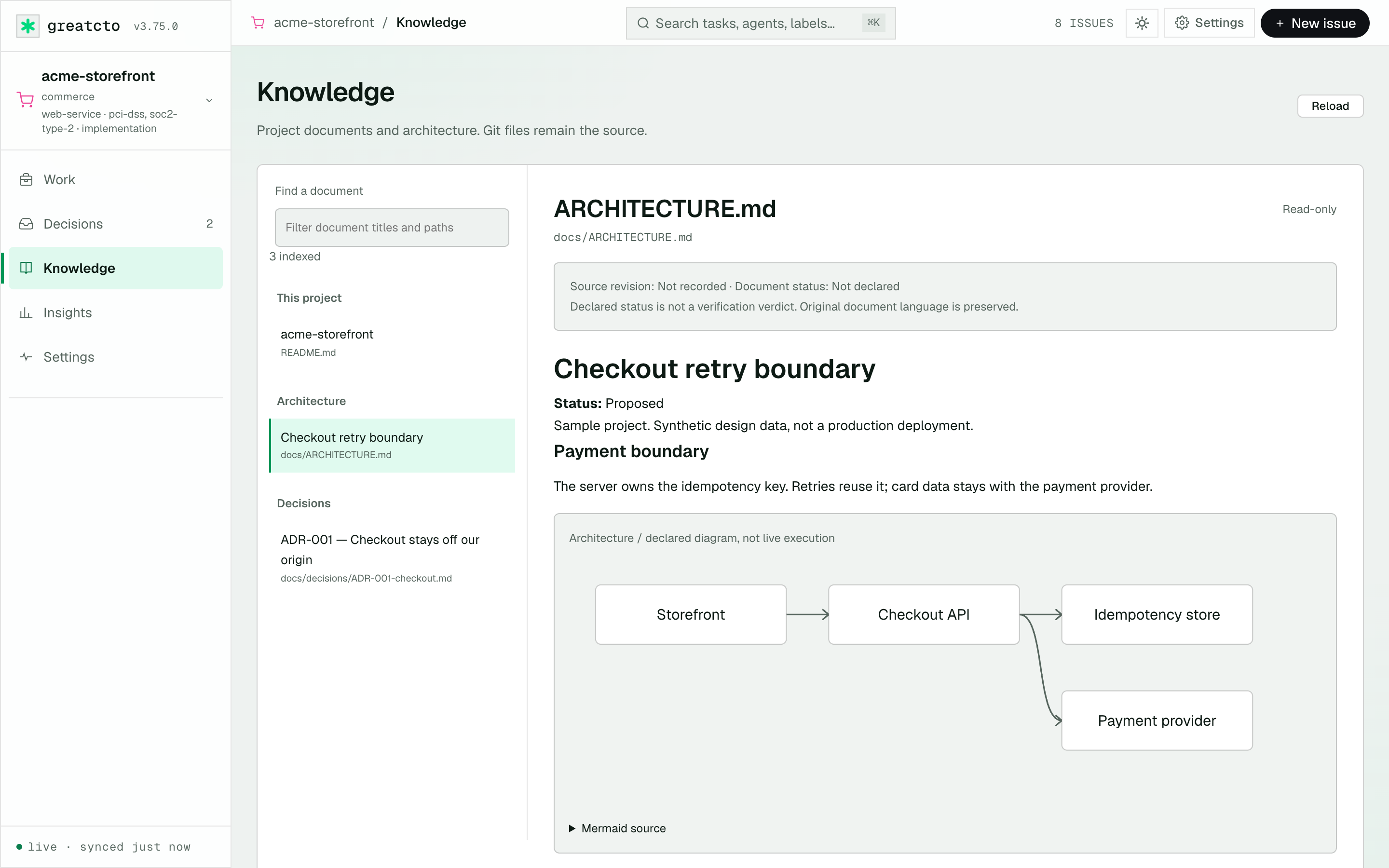
Documents keep their original language. The application interface is English. The diagram describes declared architecture, not a running task.
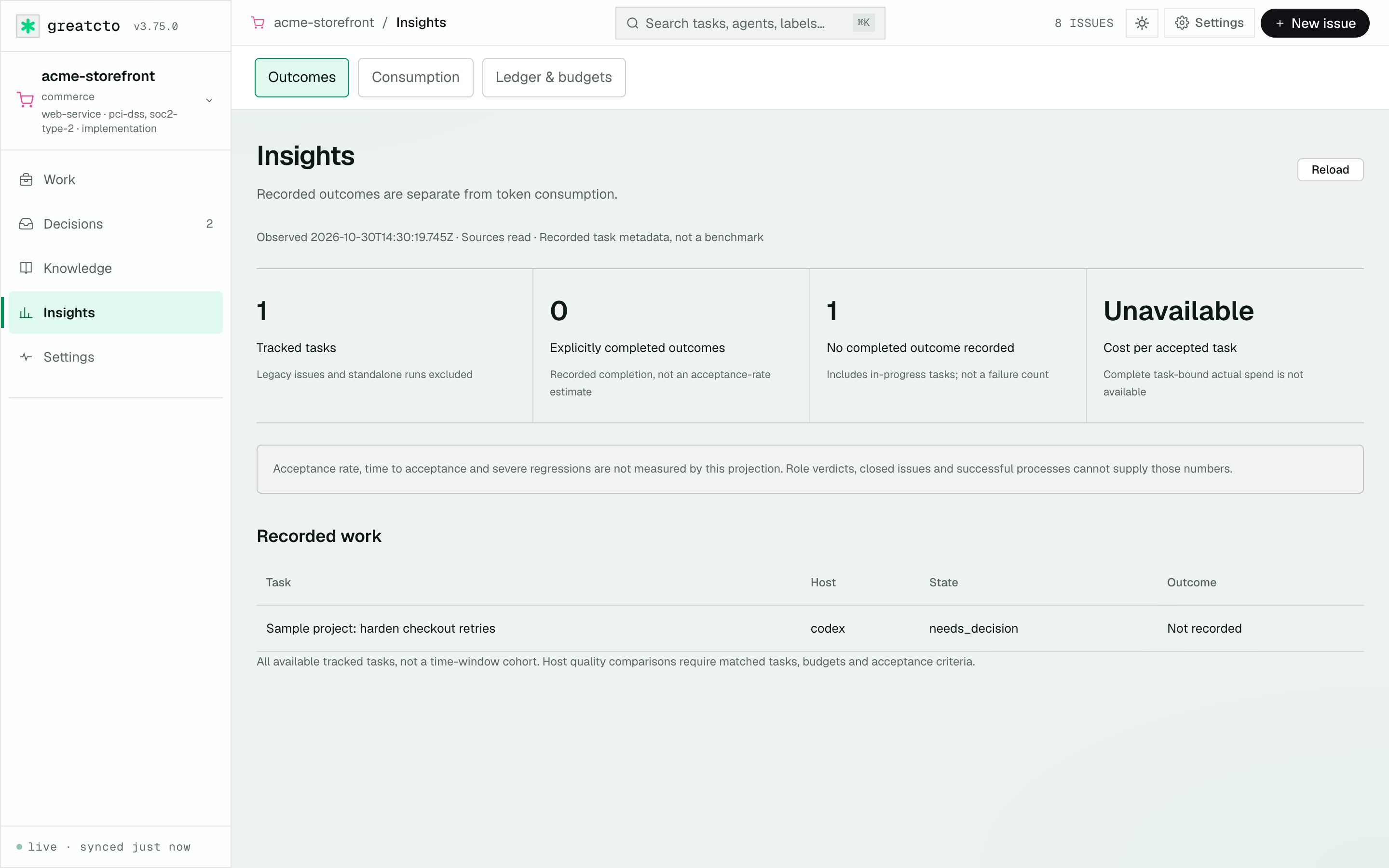
These screenshots use isolated synthetic ACME records. They do not measure host quality, acceptance rate or quality uplift. Capture contract.
Eight core roles, task-dependent specialists
| Responsibility | Role |
|---|---|
| Problem and acceptance | product-owner |
| System design and tradeoffs | architect |
| Plan and dependencies | pm |
| Implementation | senior-dev |
| Independent code review | code-reviewer |
| Verification and regressions | qa-engineer |
| Risk and ship gate | security-officer |
| Authorized deployment | devops |
These are responsibility contracts, not eight mandatory model calls or eight concurrent agents. Project focus is a presentation view; it does not remove specialists, change dispatch or waive required checks. Risk-specific reviewers remain governed by project policy.
Web frontends and mobile builds are not deployed by devops: it hands them to
release-manager, which builds once from the CI-green commit, stages the build on a
preview URL or an internal test track, has e2e-test-engineer test that exact build,
and promotes or prepares the store submission only after gate:release. A release
counts as done when its receipt in .great_cto/releases/ names the build, the tests,
the landed version and the rollback. /release ship <web|ios|android|ota> starts it.
Focused engineering context
Five versioned, opt-in domain pack candidates cover four focus areas:
| Area | Engineering invariants | Boundary |
|---|---|---|
| Money & crypto execution | Payment idempotency, ambiguous sends, scoped authority; signing boundaries, paper/live separation and chain finality | Two technical packs; no investment-performance claim |
| Telemedicine workflows | Clinician authority, prescription state transitions and evidence integrity | No clinical efficacy or certification claim |
| Venture evidence | Claim provenance, entity lineage and quarantine of unverified assertions | No investment-outcome claim |
| Mental wellbeing safety | Subject isolation, crisis escalation precedence and clinical-claim boundaries | Separate from diagnosis, treatment and clinical validation |
Packs add engineering context. They do not broaden permissions or change required-reviewer routing. Their presence does not prove invocation, expertise or better outcomes. No quality uplift from matched core-versus-pack trials is established. Private project overlays are not part of the public showcase.
On OpenAI Codex
There are three distinct modes, not identical native integrations:
| Mode | Execution and authority |
|---|---|
| Claude Code native pipeline | Native commands, specialist roles and hooks; decisions stay in the linked host |
| Controlled Codex / mixed-host pipeline (experimental) | Controller-owned role routing, validated text proposals, verifier and explicit gates |
| Codex plugin in an ordinary session | Skills, MCP and safety hooks; installation alone does not start the controlled pipeline |
Mixed runs can assign roles to either CLI. Eligible review joins can inspect the same frozen tree concurrently; this is not two writers editing the same worktree. Both CLIs must be installed and authenticated. See the host guide for routing, recovery and manual-action boundaries.
In the legacy 3.70.1 installation flow, npx great-cto init --host codex gives Codex the skills, the MCP server and six
safety guards as plugin hooks (approve them once: run codex in a terminal and
choose Trust all and continue). An ordinary Codex plugin session does not
automatically run this project's native Claude command/role lifecycle.
The Codex installation has no native plugin surface for these slash commands
or role agents. The remaining Claude workflow hooks do not silently run there.
Start the controlled pipeline through the CLI instead:
great-cto run "add Google login" --host codex --allow src,tests,docs
great-cto status --host codex
great-cto resume --host codex
The legacy 3.70.1 plugin refresh is explicit by default (great-cto upgrade codex).
In this implementation, native refresh and timer enable refuse before mutation
pending a verified no-fetch activation contract. Previously installed timers
retain their existing code until an authorized migration.
In the legacy 3.70.1 macOS flow, sh scripts/codex-auto-update.sh enable opts into a six-hour per-user timer;
status inspects it and disable removes it. Each tick validates the Git
marketplace origin before asking Codex to upgrade. It follows the configured
Git ref, not npm releases, and changed hooks still need host review in a new
session. Details, mixed runs and Codex as the second reviewer:
Codex host guide.
When it stops you
One line in .great_cto/PROJECT.md:
approval-level | Stops you at | Stops |
|---|---|---|
ship-only | the deploy — and briefs you on what gets built | 1 |
product-only | what we build · whether it ships | 2 |
gates-only (default) | what we build · the design · the deploy | 3 |
strict | the design · code review · the deploy | 3 |
auto | nothing in the pipeline | 0 |
Regulated products — fintech, healthcare, gov — keep their security, compliance
and ship gates at every level. A production web promote, a store submission or a
production OTA update always stops at gate:release, auto included. How the gates work.
Numbers, measured
| One feature, end to end, fully traced | 1h 26m · $3.40 in tokens — the receipts |
| A whole product — 7 built in the open benchmark | median $171 in tokens · 70/100 quality, measured 2026-07-10 — reproduce it |
These are historical observations, not a benchmark of the current two-host pipeline or domain packs. No quality-uplift percentage is established. Domain packs remain opt-in; their presence does not prove expertise or better outcomes.
Limitations
For one builder, not a team; not a hosted app builder — it needs your coding agent; not a CI/CD system; compliance scaffolds are starting points, not certifications; LLM output is not deterministic. The honest version of each, and what it refuses to claim: docs/DETAILS.md.
Learn more
Docs · Getting started · Commands · Gates · Agents · FAQ · Everything else · Issues · Security · Contributing · Privacy — telemetry is off by default
MIT — LICENSE. Built by @avelikiy. If it saved you time, a star helps other solo builders find it.
More from this repository6
An open-source engineering OS for Claude Code that orchestrates 51 specialist agents including architect, PM, senior-dev, code-reviewer, QA, security, and DevOps roles. Covers 16 domain packs (voice-AI, clinical, HR-AI, fintech, and more) as a local-first alternative to Devin for solo CTOs.
Skill
Skill
Skill
Skill
Skill